
The Interview Question Nobody’s Asking
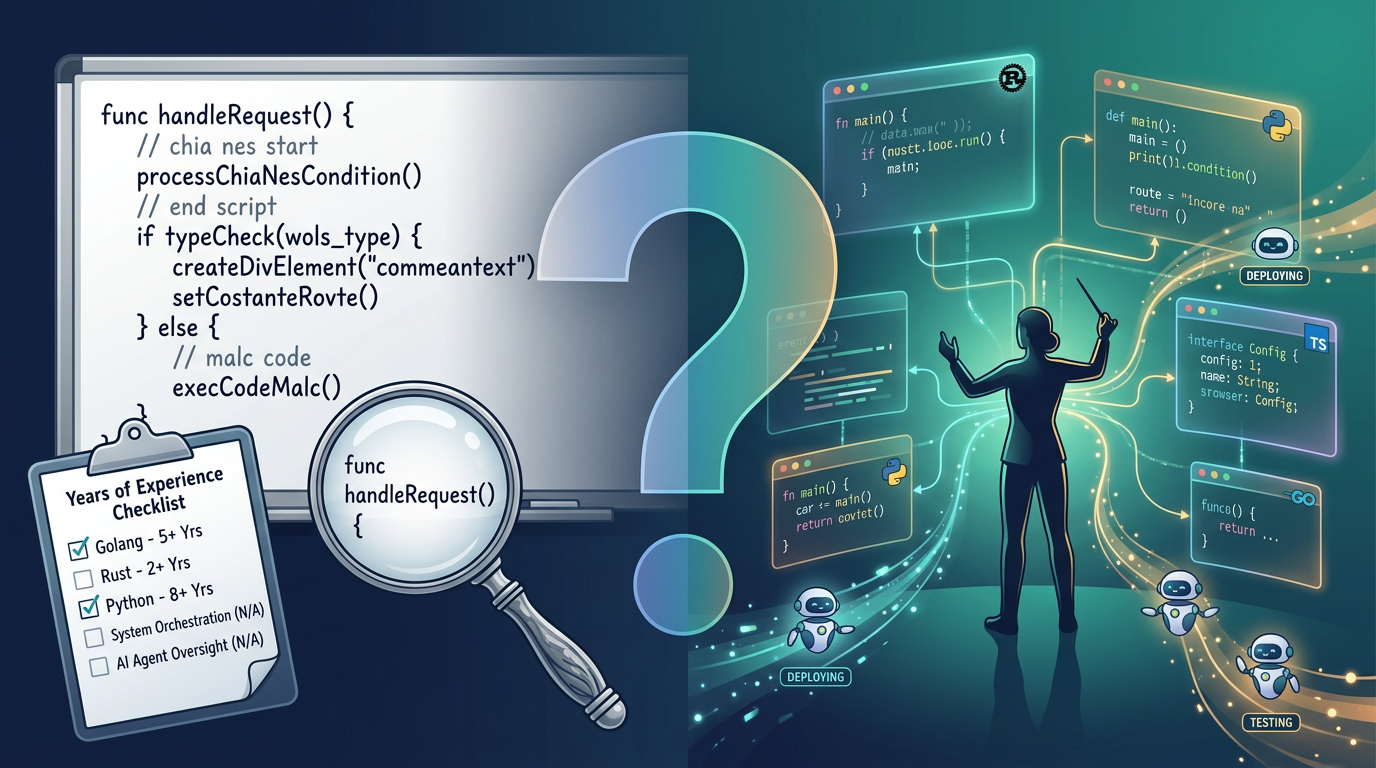
I’m currently looking for full-time work. After spending the better part of six years at Decian designing and shipping a fully functional, revenue-generating cybersecurity SIEM platform—one that transformed a local MSP from a services company into a product company with meaningfully larger margins—that role has naturally transitioned to ad-hoc support and maintenance. The platform is running. The revenue is recurring. My part is mostly done.
So I’m interviewing. And what I’m finding is disorienting.
The Disconnect
The vast majority of roles I’m applying for are hiring individual contributors with deep fluency in specific languages. Go engineers. Python engineers. TypeScript engineers. The job descriptions read like they were written in 2019—specific framework experience, years with a particular language, maybe a system design round where you whiteboard something on a call.
These aren’t fly-by-night startups. These are reputable, growing software companies with real products and real traction. And not one of them has asked me about agentic coding. Not in the job description. Not in the screening call. Not in the technical round.
At a recent interview, the conversation was politely cut short. They were looking for someone with more recent advanced Go experience. Fair enough—I respect a team that knows what it wants. But they graciously offered to let me ask a few questions anyway, and I took the opportunity to ask the principal engineer what their company’s exploration of agentic coding looked like.
He told me that he and one other developer had gotten Cursor subscriptions last month.
Last month.
I kept my composure, but my figurative jaw hit the floor. They had just passed on me for insufficient fluency in a language whose syntactic mastery is rapidly becoming a commodity—and in the same breath revealed that their entire exposure to the force making it a commodity was two IDE subscriptions purchased thirty days ago. Somewhere, a leaner competitor is about to eat their lunch and dinner for a song. The business model I was trying to persuade them to pay me to participate in is, in its current form, irreversibly broken—and they don’t know it yet.
That exchange is why this article exists.
The Paradox I Can’t Solve in 45 Minutes
Here’s where it gets personal. I don’t bring up my agentic experience in these interviews. Not because I’m not proud of it—I am. But because I haven’t figured out how to articulate, in the compressed context of a technical screen, that for the past year I’ve been honing the skills that make the effort of refining syntactic expertise in a single language look like polishing brass on a sinking ship.
The problem is optics. AI-assisted development makes me look worse at the languages I’ve worked with my entire career. My unassisted recall of language-specific idioms has atrophied—not because I’ve gotten dumber, but because I’ve been spending that cognitive budget on something more valuable: learning how to decompose problems precisely enough that a tool can implement them across any language.
Does AI make foolish errors? Absolutely. Does it confidently fill in blanks with plausible nonsense when your specification is ambiguous? Daily. But dismissing agentic tools because they hallucinate is like refusing to use a calculator because it can’t tell you which equation to solve. That was never its job. That’s your job—and it’s the harder one.
The real skill—the one I can’t whiteboard in 45 minutes—is figuring out how to leverage what AI is extraordinary at while mitigating what it’s terrible at. And that never happens if you give up the first time it does something you don’t expect. That’s like selling your power drill because it made a terrible screwdriver. You’re not wrong about the screwdriver part. You’re spectacularly missing the point.
The Skeptics
I’ve largely stopped engaging with the vocal anti-agentic crowd—the “real programmers don’t need AI” discourse that cycles through my feed weekly. Not because they’re stupid; some of them are genuinely brilliant engineers. But the argument requires me to un-experience something I’ve already experienced, and I don’t know how to do that. It’s the same energy as arguing with a flat-earther. The evidence isn’t the obstacle—the willingness to look through the telescope is.
A Language I’d Never Written
Concrete example. Rust had been on my list for years. After reaching a reasonable proficiency in advanced Go, Rust promised everything Go offered and more—unparalleled memory safety, zero-cost abstractions, fearless concurrency—at the cost of a compiler that cross-examines every line of your code like a hostile attorney.
Around mid-2025, I shipped a production HubSpot-to-Airtable sync conduit in Rust. YAML-based property mapping, full error handling, production deployment. Under a day.
It’s been running like clockwork without a single bug since then.
That wasn’t possible because I mastered Rust syntax overnight. It was possible because I knew how to decompose the problem, specify the constraints, define the interfaces, and let the tool handle the implementation within boundaries I understood. The tool wrote the Rust. I wrote the specification that made the Rust correct.
And that Rust conduit wasn’t a one-off. The same approach is what empowered me to architect and deliver the Decian cybersecurity platform at a velocity I hadn’t experienced on any previous team. More recently, I’m leveraging CrewAI to orchestrate multi-agent teams that simplify ERPNext implementations, a capability I’m already putting to work on booked project engagements. This isn’t a hobby. It’s compounding.
The Foundation That Makes It Work
I want to be clear about something: my experience is my strongest asset. Not despite agentic tools—because of them.
Agentic coding is an amplifier. Feed it clarity, get quality. Feed it vagueness, get plausible garbage. The ability to produce that clarity—to know which questions to ask, which edge cases matter, which architectural tradeoffs will bite you in six months—comes from twenty-five years of building software. Data structures, concurrency models, API design, failure modes, the instinct for when something looks right but smells wrong. None of this works without that foundation.
A junior engineer with Cursor is still a junior engineer. A senior engineer with Cursor is something the industry hasn’t figured out how to hire for yet—and that’s exactly the gap I keep falling into during interviews.
The Uncomfortable Math
So here’s the part that might sting.
If your strongest interview move is whiteboarding Go’s concurrency primitives from memory, I’d gently suggest preparing a second act. Not because that knowledge doesn’t matter—it absolutely does. Understanding goroutines, channels, and select statements reflects real depth. But the floor just dropped out from under “I can hold complex syntax in my head” as a competitive differentiator. That particular skill now costs twenty dollars a month and never needs a coffee break.
The companies that figure this out first will build at a velocity that makes everyone else look like they’re standing still. And the interview question nobody’s asking—how do you work with agentic tools?—will soon be the only one that matters.
I just wish I could figure out how to say that in an interview without sounding like I’m telling them their house is on fire.
Related
- Agentic X — Earlier thinking on LLMs as implementation agents
- Agentic Coding Made Me a Better Product Manager — Why product discipline is the key to agentic productivity
- Agentic Engineering — My full methodology for AI-assisted development