 Scott Tompkins

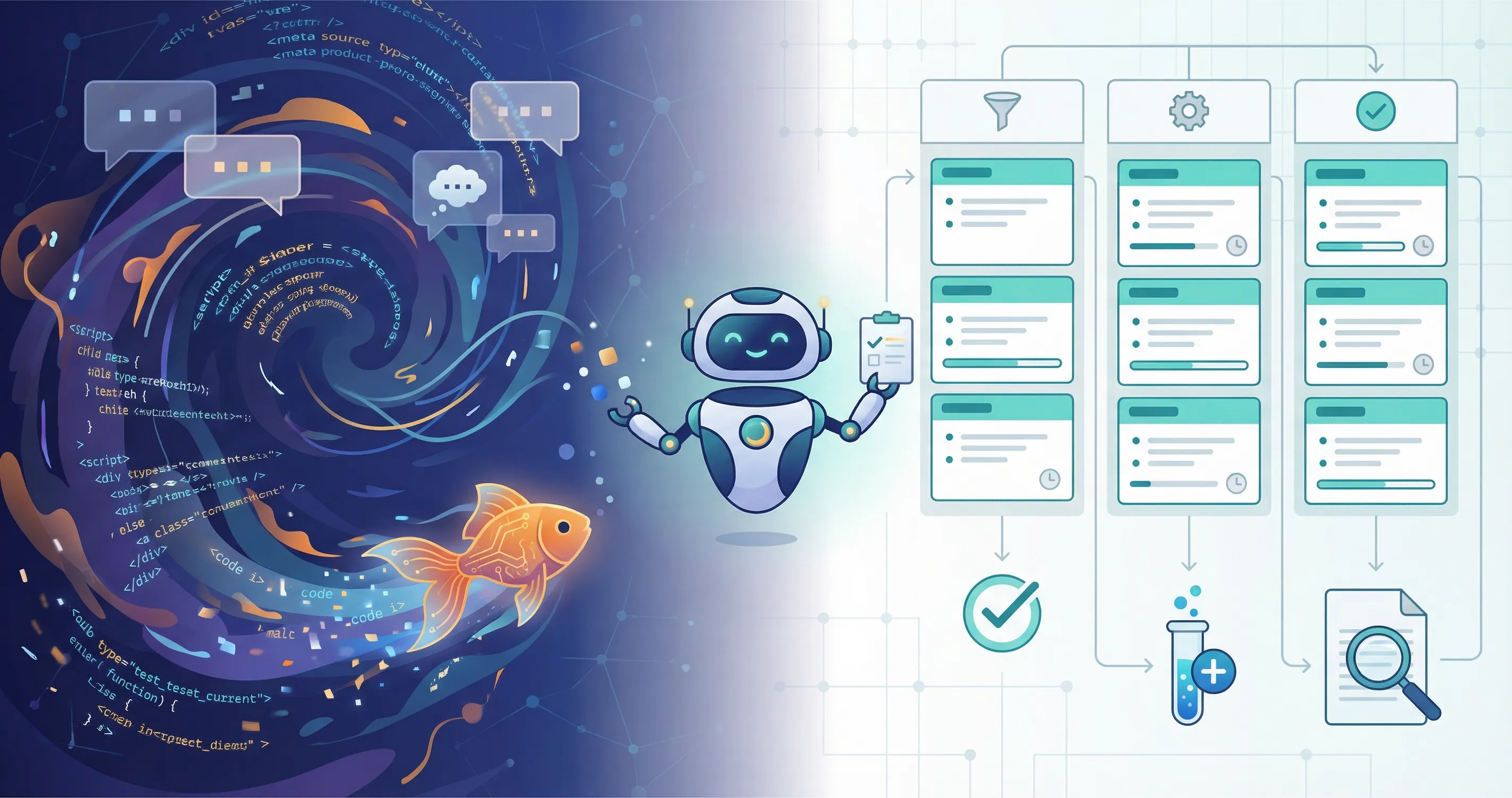
Agentic coding tools let you describe what you want and have an AI model write the code. They promise to let you skip the boring parts of product management. They have reminded me why we have those boring parts in the first place.
From disciplined to feral
In a previous role, I worked under rigorously enforced scrum. Scrum is a way of running a software team in short planned cycles, with set meetings and written-down requirements. Ceremonies were sacred. Story points were debated. Definition of Done was a living document that people actually referenced. At times it felt excessive. I got the distinct impression that some team members cared more about their adherence to the methodology than about the product or its users. Scrum for scrum’s sake.
That experience still left me with an appreciation for what good product management brings to a project, especially on a team. The reasons for the discipline are hard to see until it is gone.
Then came a startup role, much earlier in the product’s life. I tried to evangelise some semblance of good practice to the much smaller team, but concessions had to be made. We took on technical debt to deliver quickly. Perfectly tested code gave way to “good enough to ship” code. Given the context, I’d make that tradeoff again. A bug in a product that is just launching carries different stakes than a bug in an enterprise system that customers around the world depend on.
Over time, operating in that mode made me a bit feral. The discipline atrophied. Requirements lived in messaging threads and in my head. Acceptance criteria were implicit. Testing was… optimistic.
Then the tools arrived
Then came the agentic coding tools: Cursor, Claude Code and the like. My early sessions all went the same way.
Fire up the tool. Give it a prompt to build something moderately complex. Watch in amazement as it generates volumes of code that look remarkably competent. Think “this is the future.” Then actually run it, or read it carefully, and discover the gaps.
The best analogy I’ve found is managing an exceptionally fast junior developer with the memory of a goldfish. The speed is real. The capability is real. But a model can only hold so much of a conversation at once, in what is called its context window. Several prompts in, firm requirements from earlier fall out of that window and the model starts ignoring them. Binding constraints become suggestions. Decisions I had made explicitly get overwritten by alternatives that sound plausible.
What goes wrong, and why it looked familiar
Three things went wrong over and over.
When a requirement is vague, the model doesn’t ask a clarifying question. It fills in the blank. Sometimes it guesses right. Often it doesn’t, and the guess is plausible enough that I might not notice until later.
Constraints decay. The one I wrote carefully in my first prompt is gone by prompt five. The model isn’t being lazy. It is working within the limit of its context window. The effect is the same either way: requirements drift unless they are written somewhere more permanent than a chat history.
Finished-looking work hides gaps. The code compiles and the main path works. Edge cases, error handling and the requirements I never said out loud are missing.
A human team without good product management fails in the same three ways. The difference is speed. With a team, an unclear requirement produces meetings and Slack threads, someone eventually builds something, and in review you realize you wanted something else. That loop takes days or weeks. With an LLM it takes seconds. I write a vague prompt, get a vague implementation, and can see straight away that I wasn’t specific enough.
Writing stories again
I went back to disciplined story writing, and it has worked. I’m not nostalgic for scrum ceremonies. It is the only way I have found to get consistent results from these tools.
- Write a proper user story with the background, the context and the problem being solved. Not “add a feature” but “users can’t do X, which causes Y, and we need Z.”
- List the foreseeable challenges. What might be tricky? Which edge cases exist? Which constraints must the implementation respect?
- Write acceptance criteria that are specific and testable. If I can’t say what “done” looks like precisely enough for an LLM to verify it, I don’t understand it well enough.
- Ask for tests first. This is test-driven development, or TDD: the model writes unit tests before the implementation. That forces it to put the requirements into a form that runs, and the tests are still there after the conversation has fallen out of the context window.
This has given me better results than prompting again and again toward a moving target.
If writing user stories feels like a chore, LLMs are good at drafting them. I give one the rough context (what I’m trying to do, who it’s for, what the constraints are) and ask for a story with acceptance criteria. The draft usually needs editing, but it is a solid start. The model is good at producing structured text from loose input, and that covers for how badly it works when given no structure.
Diagram as text
- Me to LLM: rough idea and context
- LLM to Me: draft story, acceptance criteria
- Me to LLM: refined story
- LLM to Me: implementation, for review
The scrum practices I once found excessive are what these tools need: clear requirements before implementation, explicit acceptance criteria, a testable definition of done, and documentation that outlives the conversation. It took an AI assistant with the memory of a goldfish to remind me why those matter.