 Scott Tompkins

In short: From 2024 until I left Decian in March 2026, the company’s software ran on a Kubernetes cluster I built on five servers we owned, not on rented cloud capacity. It carried a multi-tenant SIEM taking logs from over 1,500 remote agents at 6,000–10,000 logs per second, and it held 100% uptime for the 90 days before I left.
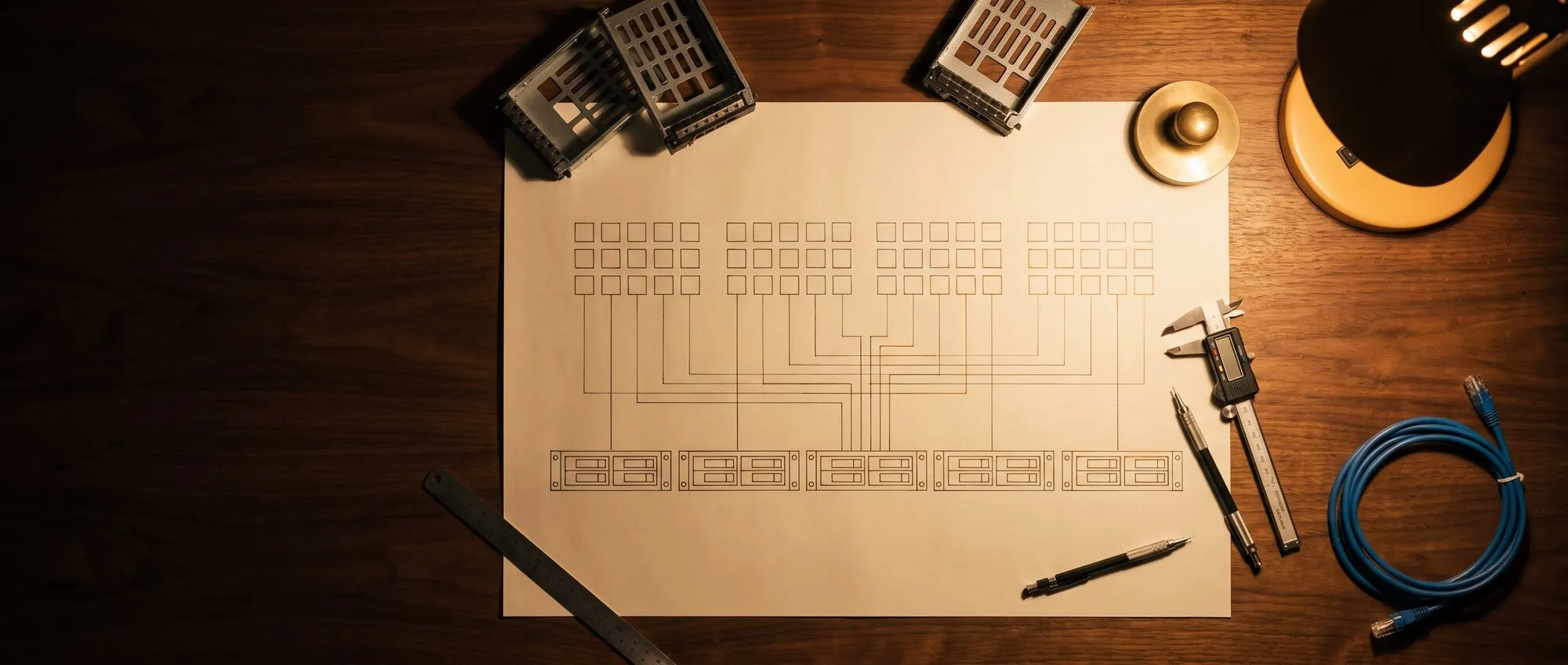
Why own the hardware
I needed to host our software economically and reliably, in a way that made scaling simple. Renting made no sense for always-on workloads with a lot of storage: a cloud bill moves with usage and is hard to predict. Owning the servers gave us cost control. It also made the resilience and scaling a cloud provider would otherwise handle our job.
That set three goals:
- Survive hardware failure without losing data.
- Scale by adding a node, not by redesigning.
- Rebuild from scratch without it becoming a multi-day project.
There was no budget for an enterprise SAN, so resilience had to come from software running on commodity hardware.
What was on the floor
Five physical servers with 896 CPU threads and 3.4 TB of RAM between them. On top of those, 21 Kubernetes nodes offering 456 vCPUs and 2.67 TB of RAM to workloads, 62 TiB of Ceph storage across 20 OSDs, and one NVIDIA A100 40GB for ML inference and rendering.
Reading the stack from the bottom:
- Proxmox VE and Ceph ran together on every server. Proxmox was a multi-node cluster with live migration. Ceph spread storage across the same machines, in tiered SSD and HDD pools. Adding a server added compute and storage at once.
- Talos Linux was the operating system on every Kubernetes node. It is immutable and driven through an API. It has no SSH, no shell and no package manager.
- Kubernetes ran as 3 control plane nodes, which held etcd and the API server and no workloads, and 18 workers in general-purpose, high-performance and GPU-capable pools.
- ArgoCD delivered every change from git. Nobody ran
kubectl applyby hand. - The workloads on top were the Wazuh SIEM and the observability platform: Prometheus, Grafana and Loki.
Where the compute went
Workloads do not all have the same shape. One uniform pool would have meant over-provisioning everywhere or starving some of them, so I ran three:
- Pool A, general purpose: 9 nodes of 16 vCPUs and 96 GB each, 144 vCPUs in all. Web services, background jobs and platform services.
- Pool B, high performance: 4 nodes of 32 vCPUs and 192 GB each, 128 vCPUs in all, with NUMA enabled. Databases, caches and search indices.
- Pool C, high performance and GPU: 5 nodes of 32 vCPUs and 192 GB each, 160 vCPUs in all. One node had the A100 passed through to it, with a taint so that only workloads asking for a GPU landed there.
- Control plane: 3 nodes of 8 vCPUs and 32 GB each, 24 vCPUs in all.
Which node sat on which server
With five servers and 21 nodes, how the virtual machines are spread decides how much a single failure hurts.
| Node group | 3 general-purpose servers | EPYC 7742 server | EPYC 7763 server |
|---|---|---|---|
| Control plane: 3 nodes, one per server | yes | ||
| Pool A: 9 workers, three per server | yes | ||
| Pool B: 4 high-performance workers | yes | ||
| Pool C: 5 workers, one with the GPU | yes |
The three general-purpose servers each carried one control plane node and three Pool A workers. Pool B ran on the AMD EPYC 7742 server and Pool C on the AMD EPYC 7763 server. Those two pools ran workloads with their own redundancy, such as database replicas and distributed caches, which can lose a node.
I split each server into several smaller virtual machines on purpose. If one large VM per server had failed, through a kernel panic or a bad upgrade, a large part of the cluster would have gone with it. With several smaller ones, a single VM failure cost a fraction of that server. It cost overhead: more operating systems to run and more memory held back for each one.
What one server failure cost
Lost with the server
1 of 3 control plane nodes3 of 9 Pool A workers
Still running
- etcd quorum: 2 of 3 nodes
- 6 of 9 Pool A workers
- Pool B and Pool C workers
- Ceph data, re-replicating
Losing one general-purpose server took 1 of 3 control plane nodes and 3 of 9 Pool A workers. The control plane kept quorum with the other two. Six Pool A workers kept running, and Pool B and Pool C were on other hardware. Ceph re-replicated the data that had been on the lost server across the nodes that remained.
Rebuilding from nothing

The whole cluster definition lived in git as Terraform. Talos took its node configuration through a declarative API, and ArgoCD deployed the workloads from git.
- Gitcluster definition, kept as Terraform
- Terraformterraform apply rebuilds the cluster
- Talosnode OS set through a declarative API
- ArgoCDworkloads deployed from git
- Rebuilds twice, a day each time
- Node access no SSH and no shell
I rebuilt the Kubernetes cluster from scratch twice, once for a major Talos upgrade and once to change the node topology. Each rebuild took a day.
What it delivered
- It ran the product. The SIEM on this cluster accepted logs from over 1,500 remote agents across WAN boundaries, at 6,000–10,000 logs per second around the clock.
- It stayed up. 100% uptime for the 90 days before I left Decian in March 2026.
- It could be rebuilt. Twice from scratch, a day each time.
- Costs were predictable. Monthly spend was power and hardware amortization, not usage-based billing.
- There was no shell to break into. No SSH on any cluster node.
- Actual state could be checked against git. An immutable OS and declarative configuration made that comparison possible at any time.
The trade
Owning the platform bought predictable costs and full control. It also made resilience and scaling our job, where a cloud provider would have handled both.
Ceph went more smoothly than I expected. Adding a server grew compute and storage together, with one cluster to monitor and one network layout to understand.
Talos asked for more. With no shell on a node, metrics and logs have to answer every question about its state. That is why the observability work came first.
A team without monitoring it trusts should count that cost before choosing this design.
Related
- On-Premise Kubernetes Platform: the design decisions and tradeoffs in more detail
- Infrastructure Specifications: server models, pool labels, storage classes
- SIEM Product Launch: the product this platform was built to carry
- Decian: the role this work belongs to