 Scott Tompkins
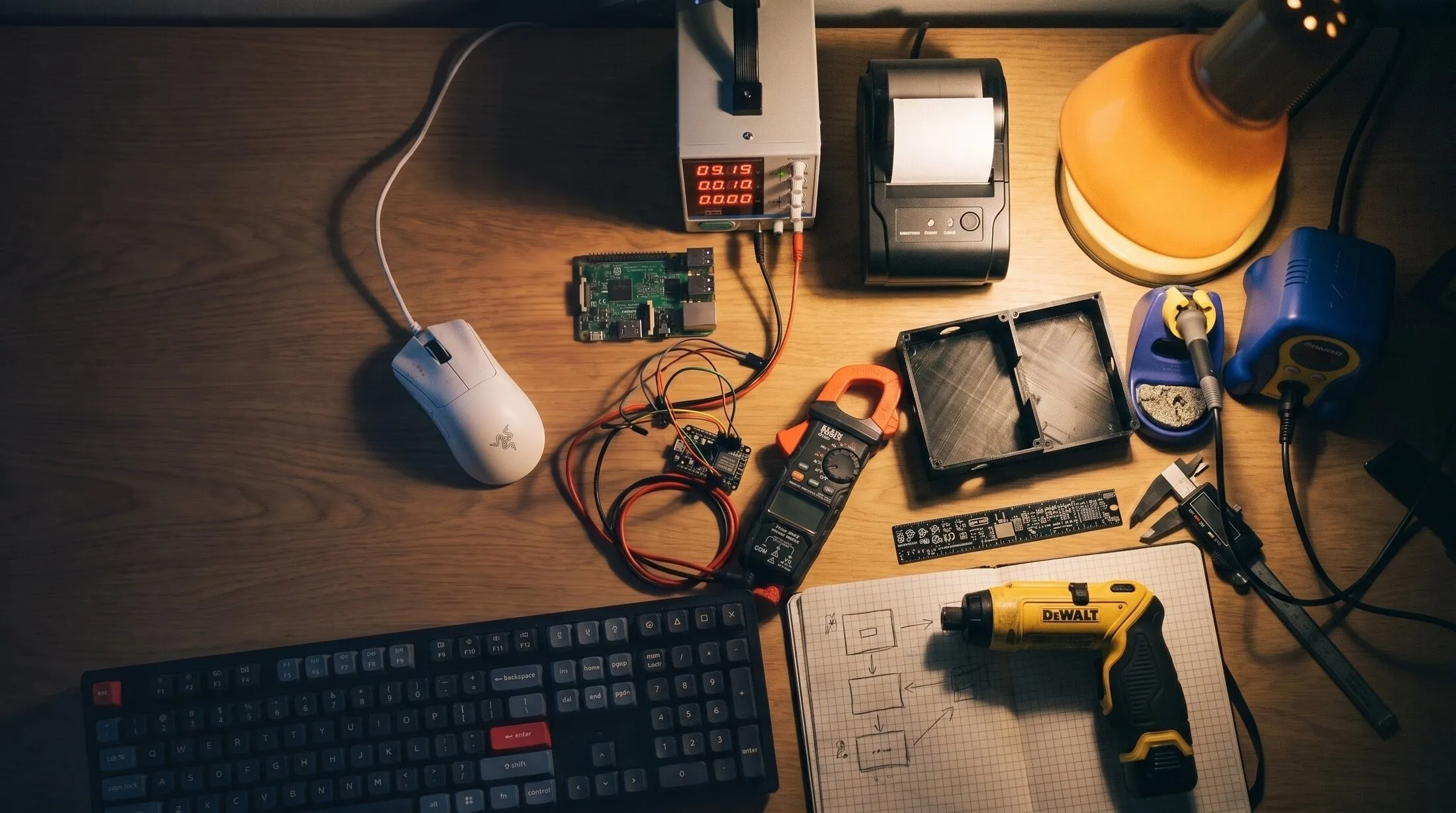
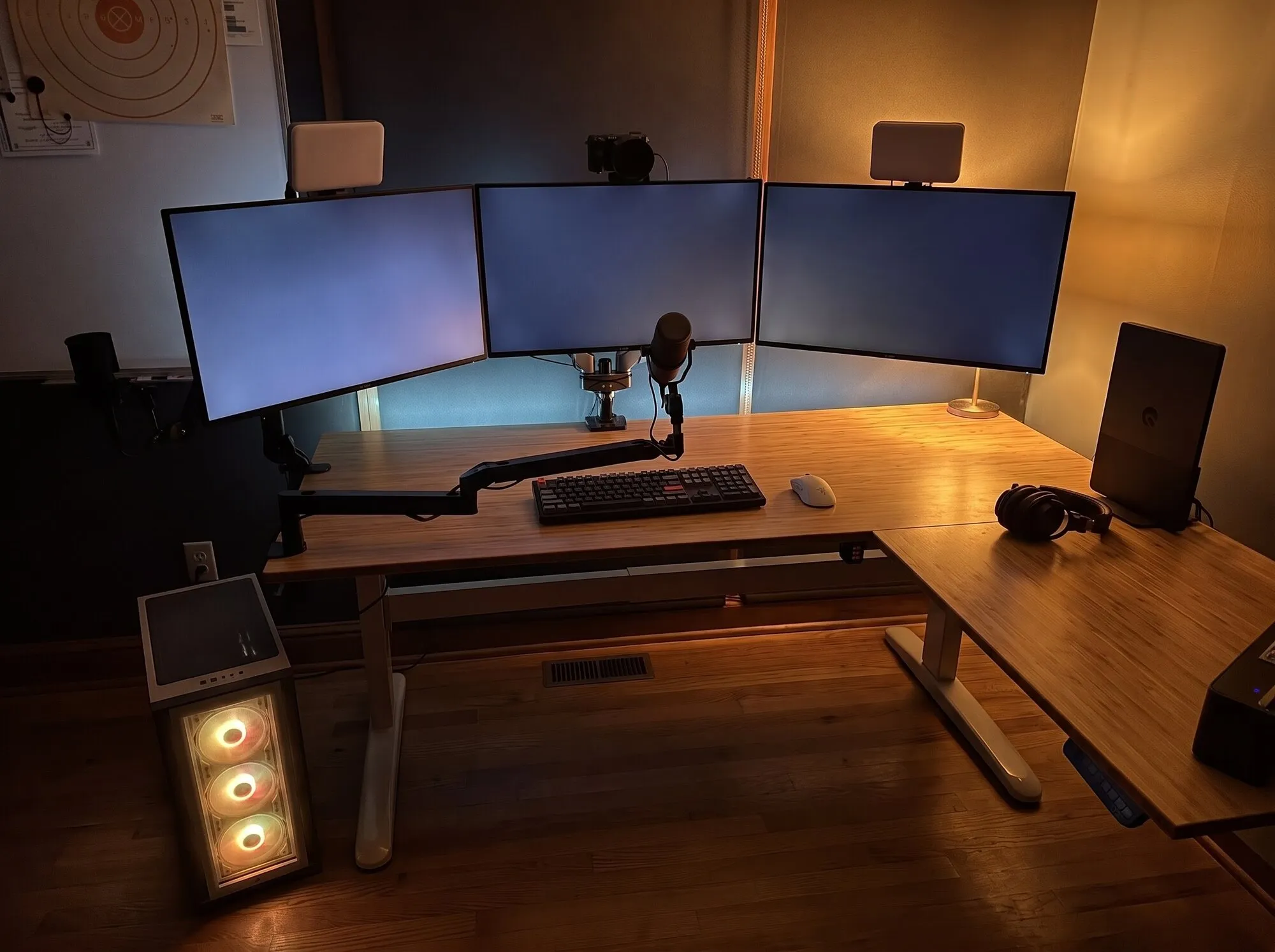
This is where the work on this site happens: one desktop PC, three displays and a microphone on an arm. It is my personal development machine, separate from the home lab, which runs the servers.
The machine
It is a desktop built around a 16-core processor with enough memory to run virtual machines, containers and a build at once without swapping to disk.
I chose the processor for its core count over raw clock speed. I do not game much, and my work is many things running side by side: several coding agents at once, or a set of microservices, which are small programs that each do one job and talk to each other. More cores suit that better than a few faster ones.
| Part | What it is |
|---|---|
| Processor | AMD Ryzen 9 7950X, 16 cores and 32 threads |
| Motherboard | ASUS ROG Crosshair X670E Hero |
| Memory | 96 GB DDR5, as two 48 GB G.Skill modules |
| Graphics | ASUS NVIDIA GeForce RTX 5070 |
| System disk | Crucial T700 2 TB NVMe |
| Data disks | Two WD Black SN850X 4 TB NVMe drives as one 7.3 TB volume |
| Network | Intel 2.5 GbE, wired |
The processor also has a small graphics chip built in, a Radeon 610M. I do not use it for the displays. It is set aside so that a virtual machine can be given a real graphics device of its own, which is called passthrough.
Both the system disk and the data volume use btrfs, a filesystem that can take snapshots. Swap is held compressed in memory with zram, and there is no swap on disk.
The desk
| Part | What it is |
|---|---|
| Displays | Three 27-inch 3840×2160 panels at 120 Hz, over DisplayPort |
| Keyboard | Keychron K10 Pro |
| Mouse | Razer DeathAdder V4 Pro |
| Audio | Focusrite Scarlett 2i2, 4th generation |
| Controls and capture | Elgato Stream Deck Plus and Elgato Cam Link 4K |
What it runs
The operating system is CachyOS, a rolling-release Linux distribution based on Arch, with the KDE Plasma desktop. Rolling means there are no numbered versions to upgrade between; packages update continuously.
The wired network port is set up as a bridge, so virtual machines on this PC appear on the home network as machines of their own. A share from the home lab’s TrueNAS storage is mounted over NFS.
The specifications were read from the machine on 23 November 2026.