 Scott Tompkins

The people this is for cannot be asked for ID. Many of them do not read English, and some do not read. They are standing in a line that runs out the door of a church basement or a community room, where the Wi-Fi is poor or absent. The people running the line are volunteers. FoodForms had to work for all of them.
FoodForms is a pro bono project. It is a self-service registration and check-in system for pantries that distribute food under TEFAP, The Emergency Food Assistance Program. I built it first for Connecticut Foodshare partner agencies. It takes the place of a paper self-declaration form and a spreadsheet.
This page follows one neighbor through a check-in, then lists the rules the design had to fit.
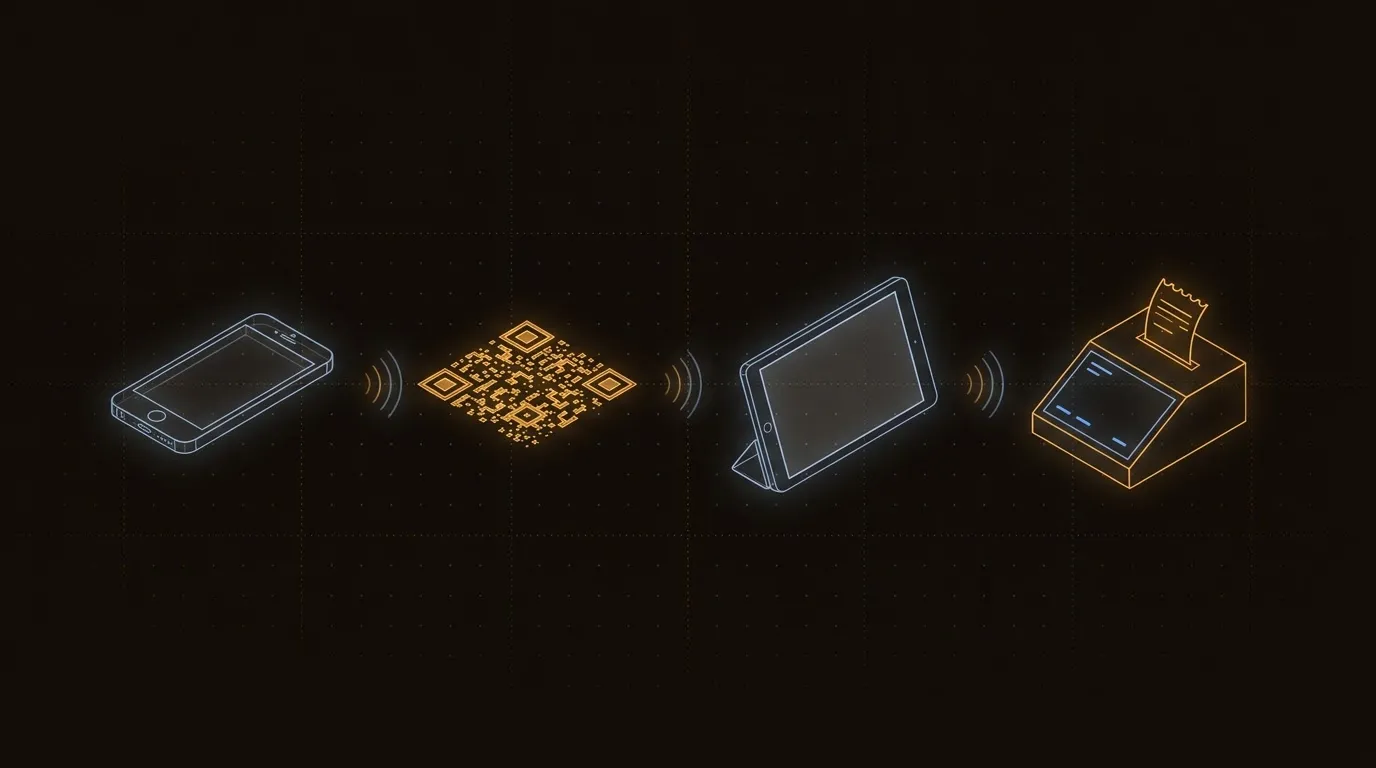
A neighbor fills in the form on a phone
A neighbor opens the phone site at home or while waiting in line and fills in the form. There is no account, no email address and no app store. The site gives back a check-in code to hold up at the pantry.
Identity Without Accounts explains how the check-in code carries the form itself, with no sign-in.
Diagram as text
- Neighbor to Phone site: fills in the form
- Phone site to Neighbor: check-in code
- Neighbor to Ticket printer: holds the code to it
- Ticket printer to Neighbor: ticket with number in line
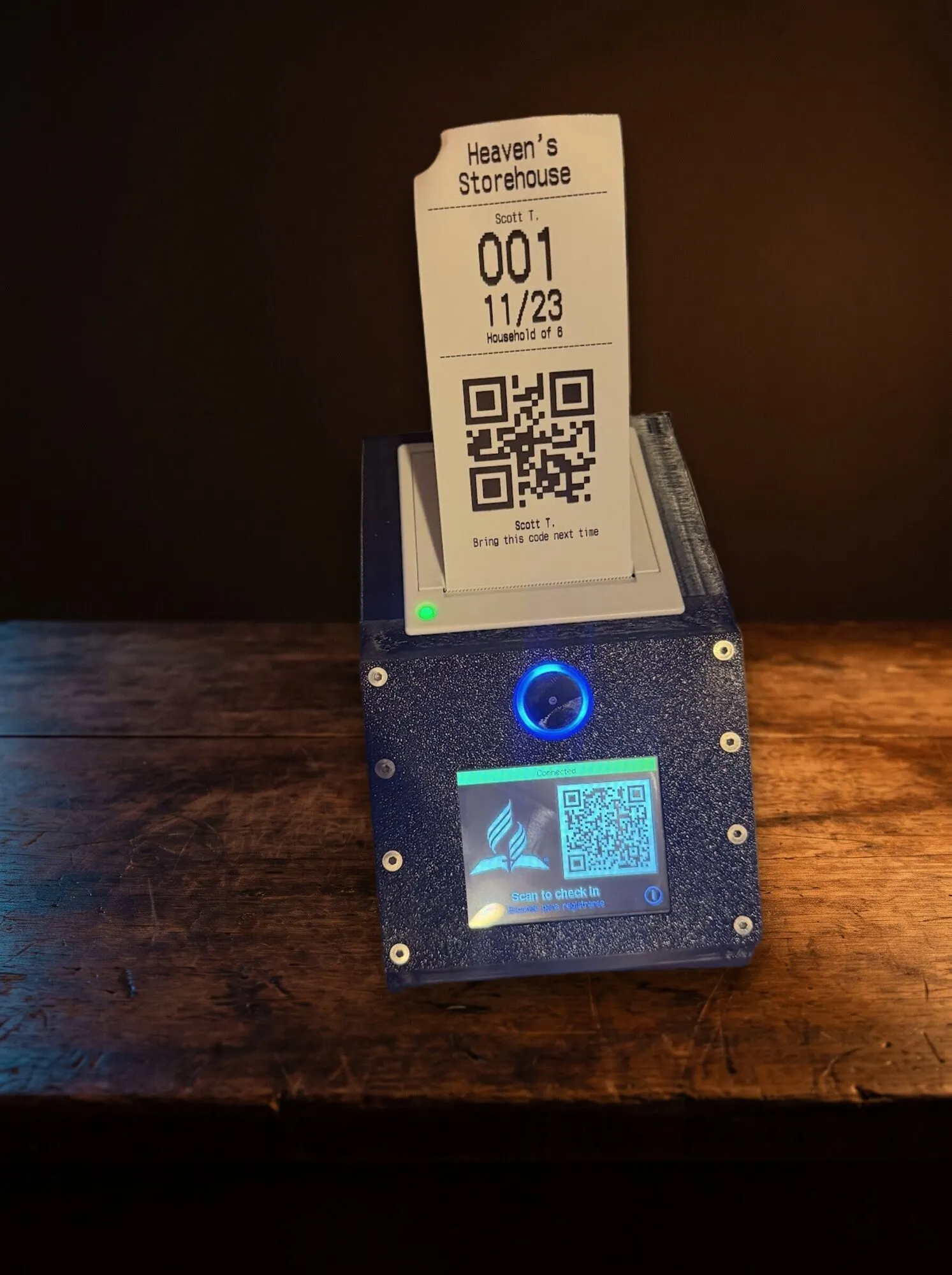
At the table, the code becomes a ticket
On the check-in table is a small ticket printer. The neighbor holds their code to it and takes a ticket with their number in line.
I designed and built the printer. Inside is an ESP32 display board, a thermal printer and a code scanner. An ESP32 is a small microcontroller. I designed the sloped desk-console enclosure too, drew it in Onshape and 3D printed it myself. The Pantry Ticket Printer covers the firmware, the scanner and the enclosure, and 3D Printing says where the enclosure came from.
A neighbor with no phone uses the kiosk
A tablet at the pantry does the same job. A neighbor checks in or registers on it, in English or Spanish, with large targets and almost no typing.
The kiosk works with no connection at all and catches up when one returns. Offline Is the Default, Not a Mode describes the local store, the sync engine and how one pantry’s data is kept apart from another’s.
Behind the table
Staff have a console for check-ins, finding and merging households, schedules, reports, and running the pantry’s team and devices.
The reporting the pantry owes is produced from the check-ins themselves. A pantry’s existing log can be imported, so nobody starts from zero.
Every pantry runs on one deployment. Each gets its own subdomain, and adding a pantry is a row in a table. No new infrastructure is involved.
The rules the design had to fit
None of these are technical.
A pantry running TEFAP has a short list of obligations. Each household confirms three statements once a year: residency, income or program participation, and a promise to report changes. The pantry keeps a participation log of name, town, household size and the date of that confirmation. Every month it reports its numbers upstream. Compliance by Subtraction reads those rules closely.
Nobody can be asked for ID. The program forbids it. Eligibility is what a neighbor says it is. Neighbors also have no account to create, remember or recover.
The network cannot be trusted. The state’s own log workbook has a print tab because computers are not always usable.
Neighbors and volunteers often do not share a language.
The staff are volunteers and there is no IT department. Whatever I built had to be something a pantry could be added to without anyone installing anything.
Eight weeks
The first commit was on September 22, 2026. Eight weeks later FoodForms was in production, with 62 recorded architecture decisions, release notes written for pantry staff instead of engineers, and printer firmware on its eighth minor release.
I set up the repository so that coding agents could carry most of the implementation while the decisions stayed mine and stayed written down. Agentic Engineering Methodology describes that working method, with this project as its case study.
There is also an essay, The Volunteer with a Spreadsheet. For an earlier offline-capable field app, built for a paying client, see SMB Ops Modernization.
FoodForms is available at foodforms.org.